Thirty years ago, in Being Digital, Nicholas Negroponte prophesied a world transitioning from atoms to bits. The reality we inhabit today is far more complex and profound than that simple binary shift.
We stand in the middle of a silent, yet utterly transformative, revolution. Its engine is the migration from the physical “atom” to the virtual “bit,” and it is now undergoing a breathtaking metamorphosis—from merely recording information, to driving processes, to thinking, and finally, to autonomous collaboration.
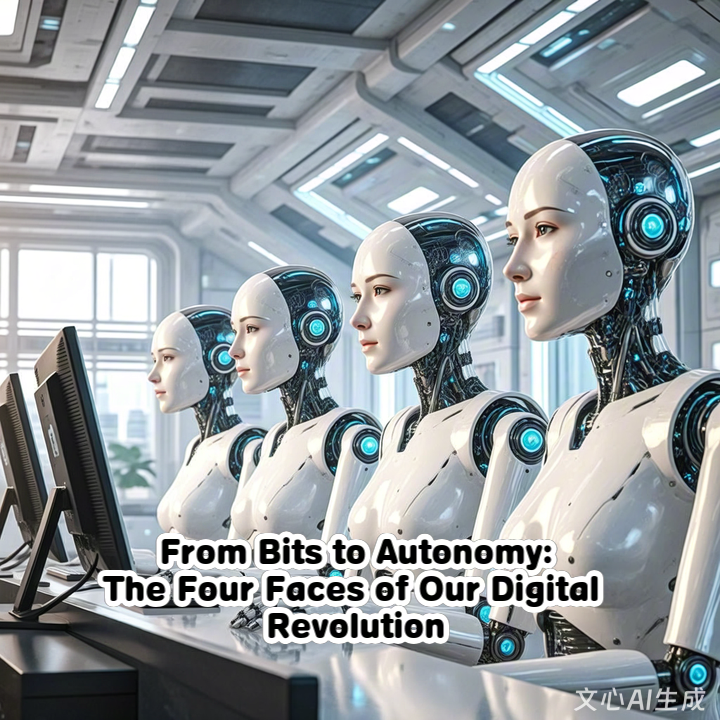
The digital age revolution is revealing itself through four consecutive, evolving faces: Informatization, Digitization, Intelligentization, and Digital-Intelligent Integration, each reshaping the fabric of our familiar world.
01 The First Face: Informatization – The Foundation
The inaugural face of the digital revolution is Informatization. This was the phase of teaching society to “do its homework.”
Prior to this, operations relied on paper forms, manual handoffs, and experiential decision-making. The core value of informatization was to make all this electronic, standardized, and recordable. For the first time, managers could “see” operations through systems, moving beyond oral reports.
However, data at this stage was a static, structured byproduct. Systems were essentially tools for recording and archiving. It was like erecting a digital scaffold for a building—creating a “digital shell” without yet infusing it with soul or muscle.
02 The Second Face: Digitization – The Engine
With its second face—Digitization—the revolution triggered a qualitative leap. This was no longer about porting offline processes online, but about reorganizing business workflows themselves with data streams.
The watershed is the establishment of a “Data-Driven” paradigm. Every operational action and state change is translated into data in real-time, which in turn precisely guides the next action. Decision-making becomes quantifiable and optimizable.
If informatization allowed a business to “see” its operations, digitization enables it to “understand” them. Data transforms from a backroom archive into the fuel and navigator for frontline operations.
03 The Third Face: Intelligentization – The Mind
The revolution’s third face is Intelligentization. This marks the critical inflection point where systems move “from rules to models.”
Previous systems executed preset rules. Intelligentization means systems begin to possess a preliminary capacity for learning and adaptation in complex scenarios. They can answer not only “what happened?” but also predict “what is likely to happen?”
Applications include predicting equipment failure, supply chain fluctuations, or market trends. Data itself becomes multi-modal, integrating device sensors, images, and text to form a richer understanding.
The human-machine relationship gradually shifts from “using a tool” to “partnering with a collaborator.” The depth of the revolution begins to touch the level of simulating and augmenting human cognition.
04 The Fourth Face: Digital-Intelligent Integration – The Organism
Today, we are witnessing the emergence of the revolution’s most profound face: Digital-Intelligent Integration. Often mistaken for mere advanced intelligence, its core leap lies in the reconstruction of organizational and production models.
It simultaneously builds closed-loop value chains for: the Data Value Chain, the Intelligence Value Chain, and the Organizational Value Chain.
This signifies that data becomes a manageable, tradable core factor of production; intelligent capabilities become modular units of productivity that can be freely combined; and organizational forms evolve from rigid hierarchies to dynamic, goal-oriented networks of agentic systems.
Its ultimate form may be the “Agent Factory” or “Agentic Organization”: a collective of multiple agents with distinct roles collaborating autonomously, endowing the entire system with the capacity for continuous self-evolution.
05 Convergence and Symbiosis: The Core and Future of the Revolution
These four faces are not simple linear replacements but represent a process of capability layering and convergence. The evolutionary path is clear: processes move from electronification to self-evolution; decisions from experience-dependent to human-machine co-driven; and organizations from management systems to agentic ecosystems.
The fundamental driver of this revolution is the rise of data as a new, critical factor of production, now comparable in importance to capital and labor.
Meanwhile, digital technology, as a General-Purpose Technology, is driving disruptive changes across all industries through its strong permeation and spillover effects.
The future is coming into focus through “Digital-Physical Fusion.” The digital revolution no longer confines itself to the virtual world but deeply integrates with physical entities, moving from “product scaling” to “service scaling.”
As Negroponte foresaw, we do indeed live in a world of bits. But today, bits no longer merely represent information; they have become the core force driving the operation of the physical world, igniting new forms of productive forces, and continuously reshaping the very fabric of our organizations.
The destination of this revolution may well be an era where organizations are intelligent, self-adapting, and continuously evolving—like living organisms. We who are in its midst are both its shapers and the shaped. Understanding these four faces is the first step to embracing the future, rather than being submerged by it.
This article reflects on the macro trajectory of global digital transformation. The specific manifestations and pace may vary across different regional and industrial contexts.